

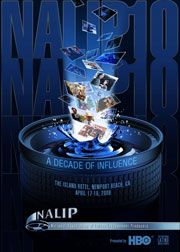
Well, almost. Had the OC prima donnas at Fashion Island in Newport Beach known what was going on under the big tent across the street at the Island Hotel this past weekend, they would have run for cover under their Beemers and Benzes. Mexicans. Puerto Ricans. Colombians. Guatemalans. Dominicans, Argentinos, most American, some not, descended on the hotel by the hundreds. And they didn't come to make the beds.
On Friday, Luis Valdez, the legendary filmmaker (Zoot Suit, La Bamba) and founder of the famed Teatro Campesino, stood under the big tent of the Island Hotel's Palm Room and told stories — of arrests, pachucos, stormy days and heydays. He reminded the crowd that once upon a time when he was a kid, sitting in a movie theater if you were brown was punishable by law. Boisterous and in-your-face truthful, Valdez implored the crowd – a mix of filmmakers, novela actors, television writers, documentary film producers and actors who had gathered for the National Association of Latino Independent Producers conference — to keep it real and keep at it. He told them to do like his mentor and collaborator “CC” (as his mom affectionately called Cesar Chavez) had done, and “make something out of nothing.”
The new “something”, by the looks of some of the films being screened and discussed at the conference, is marked by unpredictable pan-Latino narratives that span everything from the trials of a Puerto Rican Muslim rapper in Philadelphia (New Muslim Cool); to the sexual awakening of an intersex teen in Argentina (XXY) and the story of a young man who works in Mexico as a day-laborer by having his nervous system plugged into remote robots in the U.S. (Sleep Dealer).
]
The swarm of Latino filmmakers, producers, editors, screenwriters,
aspiring actors and executives crowding the hotel surpassed
Disneyland, at least for the weekend, as the happiest place on earth.
They came from around the country, (and some from Latin America), for the big, bad
conference which this year was also celebrating the ten years of
palpable influence NALIP's programs, conferences, and mentoring and
networking resources have had on an industry which, historically,
hasn't exactly held its doors wide open for Latino filmmakers. (We forget that just ten years ago there were no Latino
production companies, no bilingual programming, no children's shows
that featured Latinos and no television show which focused on Latinos
that lasted more than two or three episodes, says NALIP executive
director, Kathryn Galan).
First hatched by a group of frustrated Latino producers, educators,
actors and execs from both coasts in 1999, NALIP
today is a hefty, savvy force — part Sundance Institute (for its
success as an incubator of young filmmakers, writers and producers) and
part National Association of Hispanic Journalists (networking, job
hunting, connecting with funders and networks — with djs and tequila on the side — are all part of
the game). It's the only organization of its kind for Latino filmmakers, producers, actors, and the like.
“I'm not really suprised that it's lasted,” says Ligiah
Villalobos, a film producer (Under The Same Moon) and television writer
who sits on the NALIP board, “I'm surprised at the enormous improvement
from the first day. A lot of times you're dealing with people that just
have complaints about their situation in the industry, so it doesn't
become that productive to be with people who are just complaining. What
has been great for the last five years is that that is almost not even
allowed…It's really about encouraging people, being a support to
members, rewarding people that are doing well.”
“We needed to stay in touch with
every community where Latinos were working,” says Galan, of the effort
to keep regional programs and chapters alive and active over the years. “You do better work when you're not alone.” Efforts in the
past to do such a thing, she says, had fallen appart because they were
always volunteer-run whereas NALIP maintains a paid, active staff to
run the organization. The other side of the organization's work, one
not immediately visible at the conference, is the advocacy role it
plays in Washington. “We put together a coalition of major Latino civil
rights organizations…each one has something to say and wants to have
an impact in the media,” Galan says, “Media affects all of the work
that we do.”
As industry execs traded cards with would-be and fledgling filmmakers in hallways and after workshops (and after the parties were over), the sentiment Valdez expressed on Friday seemed surprisingly palpable throughout the weekend in an industry that isn't usually associated with kind, earthy pragmatism: “Stay independent people. Keep your heart…You've got to maintain your soul and your relationship to reality.”
